ASR Catholic School Open House Jan 29
| Jan |
| 29 |
| 11:30 am |
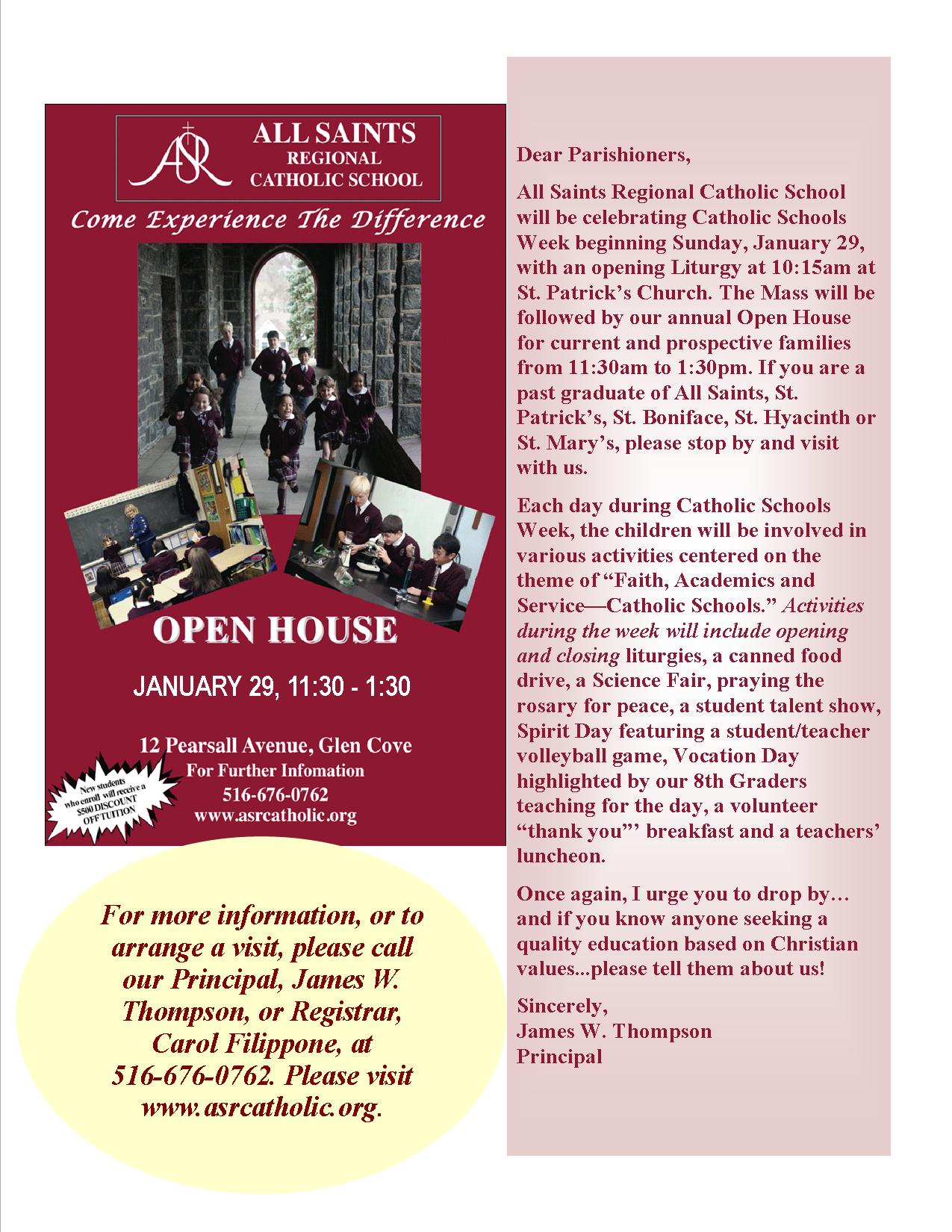
Our parish school, All Saints Regional Catholic School , welcomes you and your family to our open house on January 29, from 11:30am to 1:30pm.
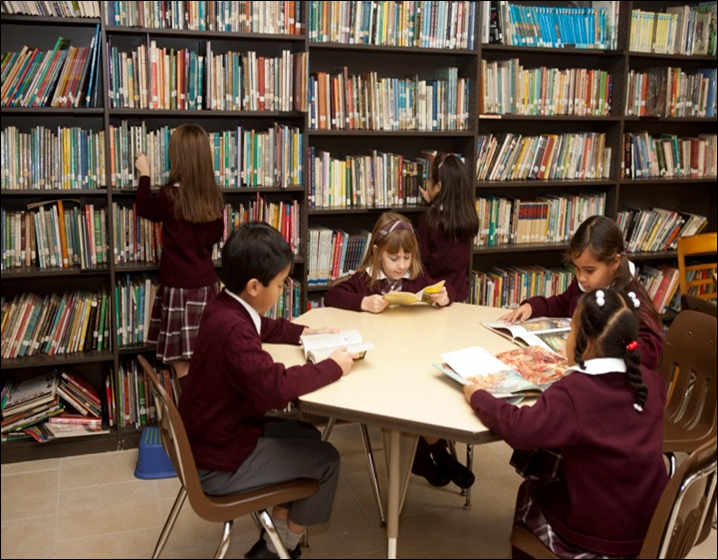
A.S.R. provides an enriching educational experience for children from Nursery through Grade 8. All Saints Regional Catholic School, founded in 1990, serves Nursery through Eighth Grade students from the Long Island, New York parishes of St. Boniface Martyr, Sea Cliff, St. Hyacinth, Glen Head, St. Mary, Roslyn,
St. Patrick, Glen Cove and St. Rocco, Glen Cove. We seek to educate our students within a family-centered Catholic community. We commit ourselves to Gospel values as we seek to develop our students’ intellectual gifts and foster their spiritual growth. Our aim is to prepare our students to lead creative and productive lives which contribute to the growth of both God’s kingdom and our nation.
Everyone is encouraged to attend our annual Open House on January 29th.
For more information on ASR see our web site at www.asrcatholic.org or call the ASR office at 516-676-0762 to arrange for a private tour of the school.
All Saints Regional Catholic School promotional video
Sea Cliff forum targets racist graffiti
January 17, 2012 by admin
Filed under Uncategorized

Photo credit: Newsday/Jessica Rotkiewicz | Rabbi Irwin Huberman, from Congregation Tifereth Israel in Sea Cliff, addresses the community and clergy about the anti-Semitic/racist vandalism that has swept through Queens and parts of Long Island during a meeting at St. Boniface Chuch in Sea Cliff. (Jan. 16, 2012)
Newsday
Originally published: January 16, 2012 8:41 PM
Updated: January 16, 2012 9:31 PM
By EMILY NGO emily.ngo@newsday.com
Gathering for a mass denouncement of recent racist graffiti, more than 100 Sea Cliff community members met Monday at a church that had been the target of what Mayor Bruce Kennedy called “anti-social behavior.”
Rabbi Irwin Huberman of Congregation Tifereth Israel in Glen Cove emphasized commonalities among audience members, whatever their faiths, and said that hateful symbols cannot be taken lightly.
“The swastika can never, never be used — even in jest,” he said.
In recent weeks, swastikas have been found drawn on homes, mailboxes, a boat and playground equipment in Sea Cliff. Similar graffiti has been reported in Brooklyn, Queens and New Jersey.
Nassau police said Monday that no arrests have been made over the graffiti in Sea Cliff.
The village has increased patrols of the area, Nassau Legis. Delia DeRiggi-Whitton (D-Glen Cove) said.
Area leaders want to ensure that “no one in our community lives in any type of fear or hatred,” she said.
Sea Cliff resident Larry Weinberger, 59, said the incidents should serve as teachable moments.
“Education is the most important thing for our children and our children’s children,” Weinberger said. “Hopefully, in future generations, there will be no hatred and animosity toward others. . . . God willing, the world will be a better place.”
Felicia Lebou, 42, of Sea Cliff, who has a 3-year-old son, suggested parents teach their children about other cultures and religions from an early age to celebrate diversity. Many who attended the forum brought their children.
Assemb. Charles Lavine (D-Glen Cove) called the vandalism “simply un-American.”
“We will not tolerate it, if we stand together as one community,” he said.
Swastikas, the words “white knights” and “anything and everything that could possibly outrage a community” were scrawled on St. Boniface Martyr Church late last month, Kennedy said. The site Monday hosted a forum where residents shared suggestions about ways to curb hate.
“Prejudice is not a prank and we will not tolerate this behavior in our village,” Kennedy said, adding that he believed the vandals to be mischievous, ignorant teenagers rather than “neo-Nazis.”
Capital Campaign – Renewing and Restoring the House of God
January 15, 2012 by admin
Filed under parish news

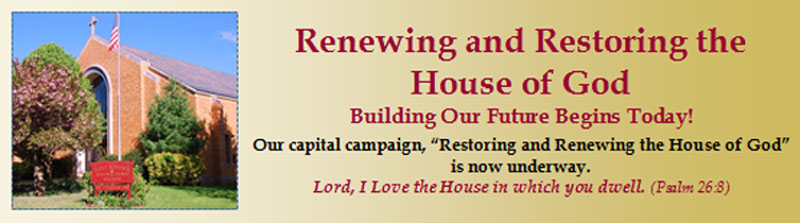
Renewing and Restoring the House of God – Building Our Future Begins Today!
Our capital campaign, “Restoring and Renewing the House of God” is still underway, and we are excited about the opportunity for everyone in our parish family to participate in this very important event. For information, call the Parish Office at (516) 676-0676.
Renewing and Restoring the House of God by Carol Griffin
Gold Coast Gazette January 12, 2012
St. Boniface Martyr Parish in Sea Cliff just completed the first phase of ”Renewing and Restoring the House of God” Campaign successfully raising more than $1,000,000 dollars in pledges to begin renovation of the interior of the church. The project that began in September and over time it has created increased enthusiasm and support. Members of the community may have noticed the barometer in front of the church noting the success of the campaign moving up from week to week until Christmas, when the success of the campaign was announced to the parish.
Parish pastor, Fr. Bob Romeo began the campaign in September with the assistance of a steering committee of parishioners, a liturgical architect, and Lynch Development secured to do a feasibility study and to manage the campaign. The goal at that point was to get the feel of how the parish community felt about supporting the plan. All of the parishioners were invited through letters and bulletin announcements to be interviewed, or fill out questionnaires. A series of parish meetings followed w here several possible design options were presented. At the meetings, parishioners were given the opportunity to ask questions on all aspects of the plan. From day one Fr. Romeo promised that if the parish on a whole was against the project he would not go forward with it but only make repairs as necessary.
In a letter to the parish community, the pastor noted that the parish is not only the House of God but it is also the House of the people of God. It is sacred space in which we encounter and worship the Living God; where God’s people celebrate their life together, through liturgy, and the sacraments. He emphasized that “in our role as stewards for future generations, we have an obligation to Renew and Restore the House of God”.
Fr. Romeo asked for everyone’s prayer support as the parish family come together in this effort. He emphasized that the joy that has been so evident in the parish’s life will be enhanced as the excitement of a “Renewed and Restored” church building draws everyone even closer.
At each meeting Fr. Romeo thoroughly explained why he wanted to do the renovations and how they would benefit the parish especially noting how the design would draw the congregation together at liturgy, provide better auxiliary space and save considerable expenses on utilities in the future by the improved heating, air conditioning and lighting.
After the introductory meetings to explain the project were held in the church, additional meetings were held in parishioner’s homes and at the church to further explain the project and to begin the pledging. This phase drew considerable support with half of the money pledged by Thanksgiving, which included several large memorial donations. At this point, the parishioners at large were asked to help by meeting each week and contacting other parishioners in their homes. It was exciting as each week the support of the project grew and grew with additional parishioners pledging to the memorials and the campaign in general. By Christmas, the parish had not only reached it goal, but went beyond it.
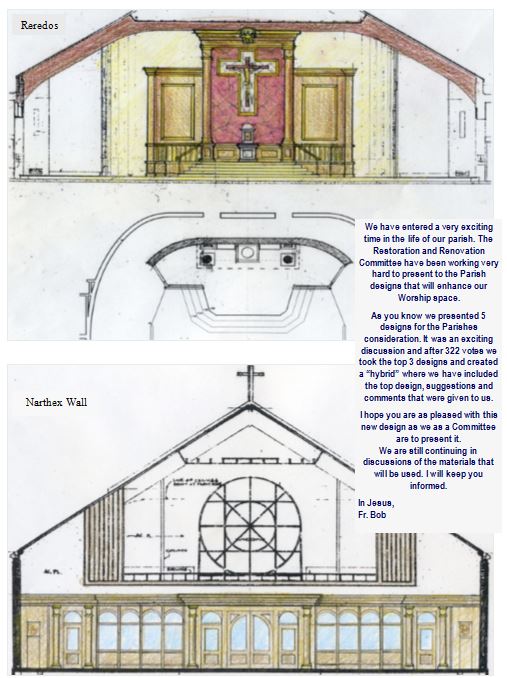
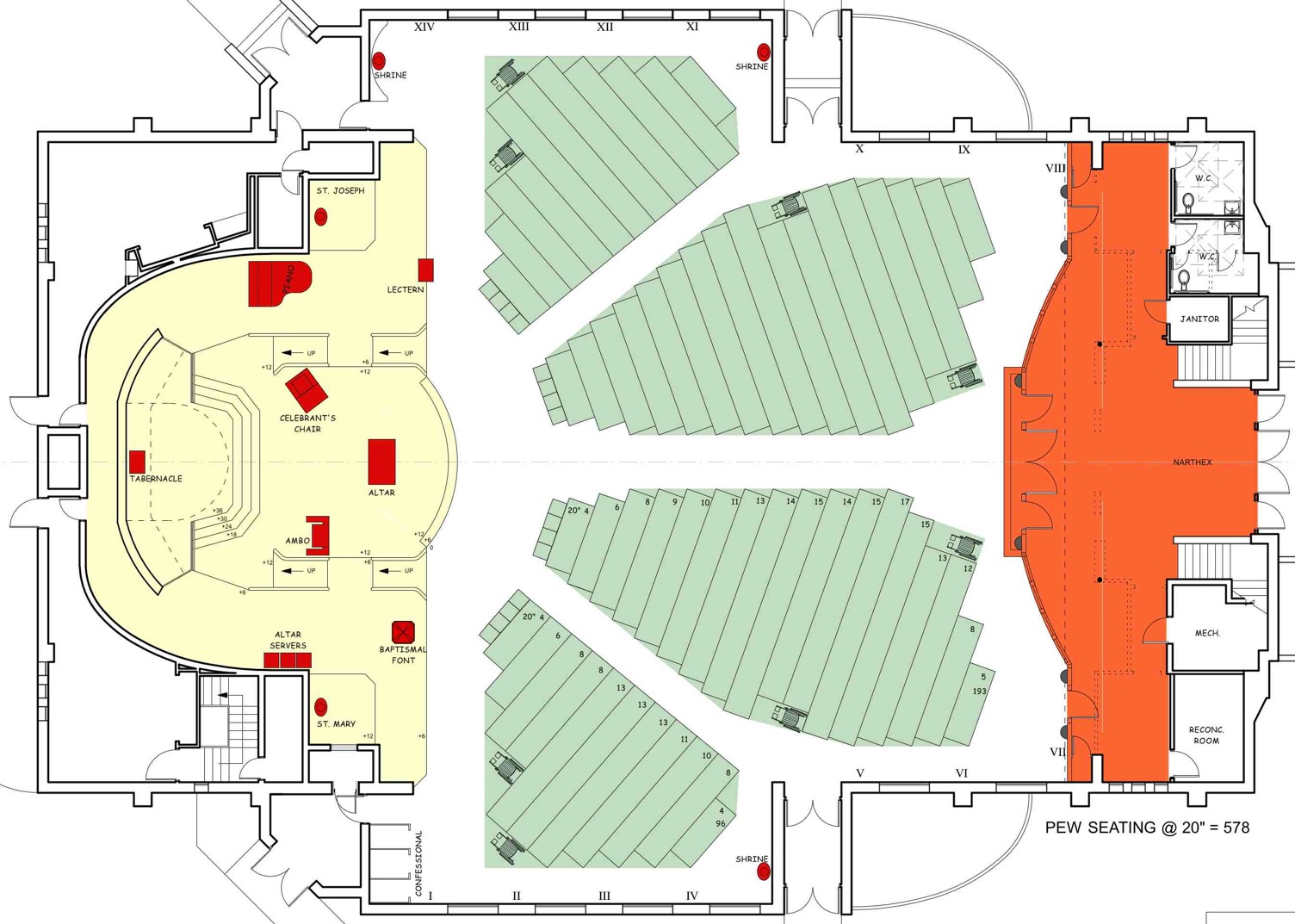
Although complete details of the design has not been finalized, the overall plan intends to honor the past and provide for the future by repositioning the Tabernacle from the side to the back of the main altar, using the original mosaic and mother of pearl door from the original St. Boniface Church, to enhance the worship environment by bringing the congregation closer to the altar by reducing the size of the sanctuary and reconfiguring the pews for easier access. The installation of a high efficient burner and conversion to gas heat has already been completed. The plans also call for energy efficient lighting, modifications to the HVAC system and installation of new restrooms including one that is handicap assessable, and repair and renovation of the existing roof, doors and windows. When the design committee formalizes the plans, the final design will be presented to the entire parish for their input.
To increase veneration and devotion to the Blessed Virgin and St. Joseph, a shrine area will be created on each side of the sanctuary using statues from the original church and move the statue of St. Boniface outside the school building to a place of honor in the new vestibule that will be increased in size to host a larger number of parishioners and guests for after Mass refreshments, meetings and other socializing.
Fr. Romeo said he is excited about the vision and the campaign. “It has already brought many blessings to the parish,” he said. “It has brought a number of the old parishioners back to the parish.”
One of the members of the steering committee said, “It was gratifying to see how the parishioners came together in support of Father Bob’s vision. Another parishioner noted, “Being involved in the campaign was very exciting by simply watching parish support grow from week to week.” Another steering committee member with a very practical mind said, “Now that we have succeeded in raising the needed funds, we must complete construction/changes on time within budget and with as little disrupt ion as possible to our parish Mass schedule and other activities. Fr. Bob has been an inspiration in leading our financial campaign effort and I am sure he will continue his fi ne leadership as we enter the next phase of the program.” Finally, another core member said she was “excited about the vision that Fr. Bob shared with the core committee early on. I believe that the restoration and changes in the church will enhance the liturgy and create curiosity for new members to join our parish. We were fairly aggressive implementing the vision which triggered the campaign but the time seemed right, the parish is alive with enthusiasm and growing. As a result of the campaign the true success is not only in reaching the goal but it was a reason to bring parishioners of all generations together to share in the vision and take ownership together. As a result many new relation ships developed among parishioners and new members feel welcome to participate in many ministries in the parish.”
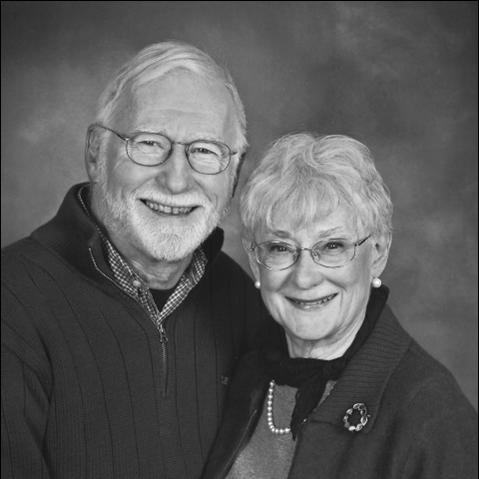
Members of the steering committee include: Kevin and Maureen Angliss, Neil and Camille Miritello, Elena Villafane and Dan Kelly, Eileen and Larry Krieb and Frank Sujecki. Several dozen other parishioners have supported the campaign in various ways to help to make the project a huge success and bringing the parish closer together.
Lord, I Love the House in which you dwell. (Psalm 26:8)
Our Church Windows
April 6, 2009 by admin
Filed under photo galleries
The following are descriptions of our church’s eight transept window that depict historically accurate events from the life of St. Boniface Martyr, whose feast day is June 5. The photographs were taken by photographer Carol Griffin of Sea Cliff.
Click on each of the thumbnail images to see enlarged photos. (All photos by Carol Griffin)
A Parish Is Born
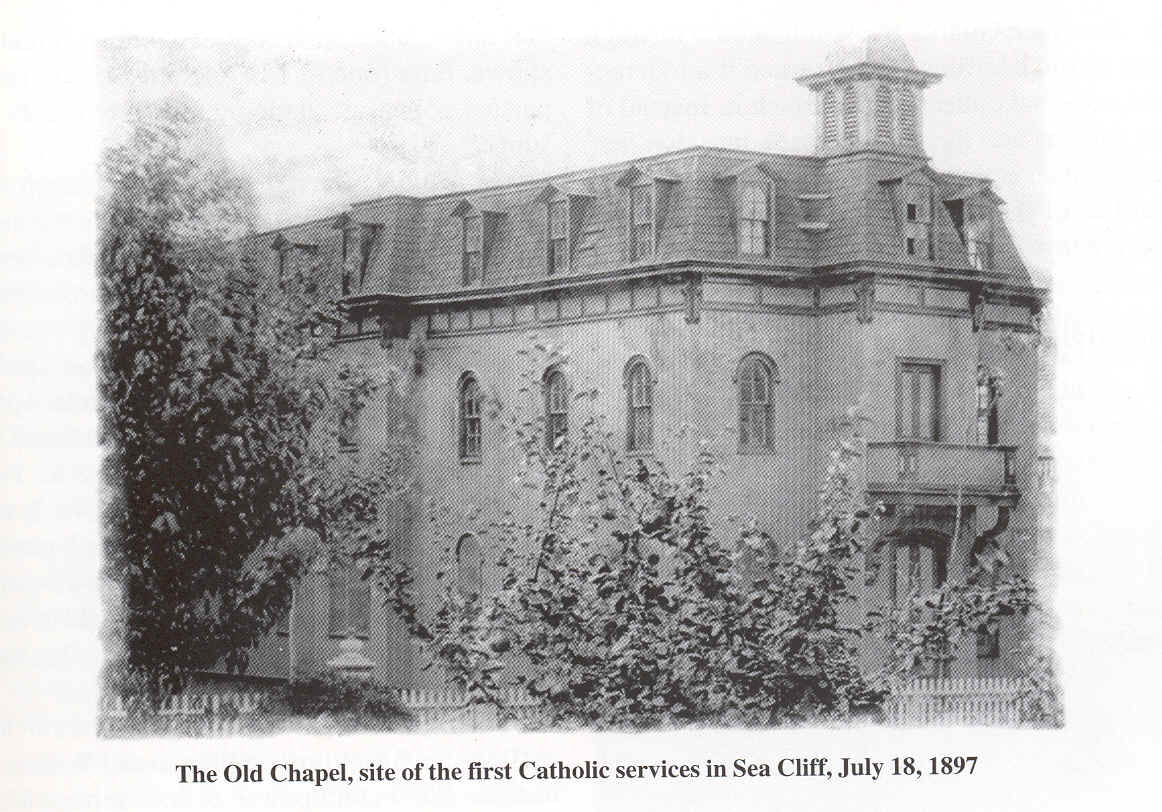
In 1668, Joseph Carpenter and a few associates purchased a large tract of land on the North Shore of Long Island from the Matinecock Indians. This area remained a quiet, rural settlement until a post-Civil War religious fervor showed itself along the Atlantic seaboard. In 1871, a group of Methodist’s from Manhattan and Brooklyn organized the Grand Metropolitan Camp Ground Association and bought 147 acres of property from the heirs of Joseph Carpenter. Over the next three decades, religious summer camp meetings and crowds of visitors transformed the area into a bustling resort town, complete with hotels, a ferry service, steamboat cruises and lovely Victorian homes. It was during this time of growth, on October 3, 1883, that Sea Cliff became an incorporated village composed of thirteen families and the pastor of the Methodist Church. As the village continued to grow, more Catholic families settled in the area. On July 18, 1897, the first Catholic services were held in the Old Chapel on 14th Avenue, just west of Central Avenue, where visiting clergymen came to Sea Cliff to conduct camp meetings. Father James McEnroe presided and was assisted by Father Frederick Lund. Throughout the following year the pair continued to travel from Glen Cove to say mass at the mission until plans for a new parish were realized.
In 1898, Bishop Charles E. McDonnell, the second Bishop of the Brooklyn Diocese, formed a new parish in Sea Cliff that he named St. Boniface Martyr, and appointed Father James J. Donohoe as first pastor. Father Donohoe celebrated his first Mass on July 3, 1898 in the Old Chapel. The Sea Cliff News of July 9, 1898 correctly predicted: “As Father Donohoe is a hustler, it will not be long before a handsome new church will be erected.” They broke ground for the edifice on January 11, 1899, and volunteers (including many non-Catholics) carted bricks and fieldstone from the Glenwood Landing dock and from the Long Island Railroad station in Glen Head. On June 11, 1899, the cornerstone for the church building was laid.
As the church was being erected, the work of building the parish also proceeded. Father Donohoe set up a Sunday School and organized a Junior Choir, formed an Apostleship of Prayer, arranged for a mission, got the Holy Name Society underway, organized the St. Aloysius and Holy Angels Sodalities, took the first census, celebrated the first confirmation, and trained the first altar boys. He set up the St. Boniface Guards for youth aged 9 through 15. He bought an old boarding house, turned it into a rectory, and held a special collection to furnish it. Instead of charging pew rent, as was the custom, an “admission fee” of ten cents was taken at the door as one entered for mass.
The social life of the church blossomed, all with the point of fund-raising. A news account of the time tells of “lectures, balls, stereopticon views, picnics, minstrel shows, fairs (one in 1897 netted $1200), concerts, lawn parties, open-air dancing, euchre (card) parties and suppers…”.
The moment the basement of the church was completed, Father Donohoe again appealed for the parishioners to harness their horse teams to carry chairs, benches and an altar to the site, where mass was celebrated on July 9, 1899. The completed church building was dedicated by Bishop Charles E. McDonnell, D.D., on April 22, 1900.
A Temperance Society was begun in April 1901 and lasted for only five years (records indicate a yearly decrease in numbers). In 1902, the first St. Patrick’s Day Supper was served, and netted $142.40. It soon became the parish event of the year, attracting people from the whole Oyster Bay peninsula. Its eat-all-you-like meal, prepared and served by the Ladies Guild in an atmosphere of carefree joy, was finally discontinued in the 1950′s for lack of ability to handle the crowds.
Father Donohoe was transferred in 1906 to St. Martin of Tours in Brooklyn, and Reverend William L. O’Hara became the second pastor at St. Boniface Martyr (1906-1909). He early became known for his civic interest, his instruction of non-Catholics, and his generosity. In June of 1906, he gave the commencement address at the Sea Cliff High School graduation exercises. It was he who urged his parishioners and others in Sea Cliff to send money to aid those suffering from the San Francisco earthquake and, later, to collect for victims of an earthquake in Italy.
The pastor who followed Reverend O’Hara was by disposition apparently something of a local John XXIII (before his time). The Rev. Louis J. Sloane, who served until 1926, managed to pay off the church debt and began the dream of a parochial school. To this end, he started to build a treasury. Father Sloane was known for his great charity toward all people. He was well liked by non-Catholics in town and made many converts. When Father Sloane was suffering from his last illness, public prayers for his recovery were said in all the Protestant churches in Sea Cliff and in the Jewish Synagogues in Glen Cove. During the last two years of Father Sloane’s pastorate, Reverend Aloysius H. Gillick and Reverend William Rhatigan served as administrators.
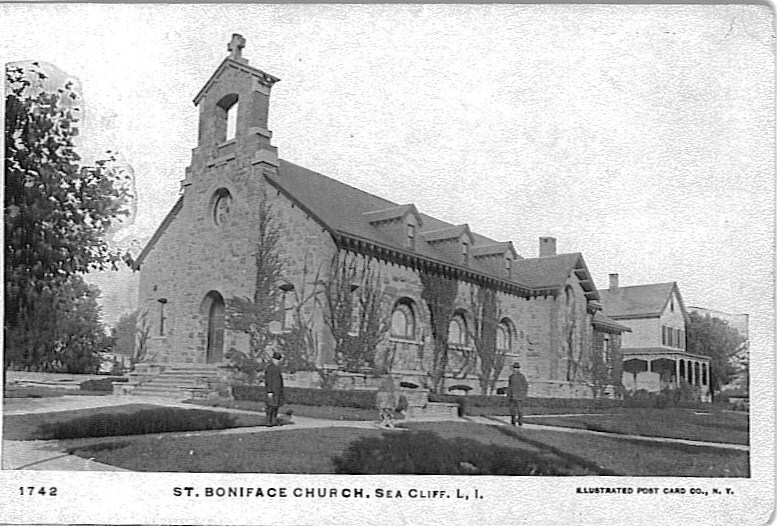
A new church bell was blessed on Thanksgiving Day, 1916, and began to ring out the Angelus three times each day and to call the parish to divine worship. Weighing one thousand pounds, the bell was made by the Meneely Bell Company of Troy, New York, and was donated by Miss Mary A. Neville. It now sits in a small brick tower adjacent to the main church building and still rings joyously to this day.
Our Community Grows
By October, 1923, a parish census showed 140 families where both spouses were Catholic, and 260 families where only one spouse was Catholic. There were then 859 Catholics in the parish. A Sunday School held at the time averaged 135 youngsters in attendance. Fifty were baptized that year; 26 made Holy Communion; thirteen couples were married; and there were 16 deaths.
The “diamond-in-the-rough” who followed Father Sloane as pastor is still remembered by some in the community: Reverend Patrick J. Ford (1926-1937). Irish-born, with a tough exterior, he was the sort of pastor who visited his flock, family by family. Carrying forward Father Sloane’s dream, the school became his great effort, and it was brought to a reality at a cost of a quarter-million dollars. It opened in September, 1928, with an initial enrollment of 150 pupils, and the Sisters of Mercy of Dallas, Pennsylvania were enlisted to teach.
When the Great Depression hit the country, it seriously affected St. Boniface Martyr Parish. Few could meet pledges made in good faith, and the church was burdened with debt. Father Ford, in 1932, organized a “conference” of the St. Vincent de Paul Society as one bulwark against personal need suffered by the parishioners and others in Sea Cliff during those stark days. To make matters worse, in 1936, an arsonist set fire to the church building on three occasions, causing heavy damage and adding to the financial debt of the parish.
When Father Ford was moved to St. Sylvester’s in Brooklyn, he was succeeded by Reverend Charles B. Garvey (1937-46), a native of Cutchogue who was one of the first vocations from Suffolk County. During his pastorate, the Confraternity of Christian Doctrine (CCD) was organized, the Confraternity of the Rosary was begun, and the Carmelite Third Order set up a chapter here.
During W.W.II parishioners knitted scarves, held blood-banks, rolled bandages, sat fire-watches, and entertained “the Boys” from Mitchell Field and Roslyn Air Base. They whispered about the strange boats quartered at Fyfe’s Shipyard in Glenwood Landing that were tested up and down the harbor (which they later learned were the “PT Boats” of Pacific fame). They wrote a lot of V-Mail letters and also held special prayer services for a victorious D-Day. As a matter of fact, they did a lot of praying! During the war, more than 400 men and women of St. Boniface served in the armed forces and of these, 15 made the supreme sacrifice of their lives.
During the era of post-world war prosperity, many Catholic families moved out to the suburbs and into the parish. Despite the return to better times, many still felt the pinch of the long depression. To aid them in adjusting financially, while helping them avoid the high interest rates of the loan companies, a cooperative credit union was established among the parishioners. Small loans at very low interest rates were of untold value.
Father Garvey died as pastor in 1946, and was succeeded within a month by the Reverend William J. Gately. Under Father Gately’s leadership, the parish debt was paid off, and the church, school, convent and rectory were repaired and redecorated.
In May, 1947, a census revealed that the parish had grown to 1,198 families representing 3,645 individuals. During Father Gately’s stay, the parish celebrated its Golden Jubilee in 1948, with a Solemn Mass of Thanksgiving, with the Most Reverend Thomas E. Molloy, Bishop of Brooklyn, presiding. Father Gately was instrumental in establishing a Mothers’ Club as a support for the parochial school.
In 1952, Reverend Thomas W. Smiddy succeeded Father Gately. After a year of dedicated pastoral work Father Smiddy, in 1953, was transferred to the Chancery Office in Brooklyn where he was eventually elevated to Papal Chamberlain as a Very Reverend Monsignor. In exchange, the man who held that post in Brooklyn, Very Reverend Monsignor Vincent J. Baldwin, came to St. Boniface. He was aided in his adjustment to the life of pastor by Fathers O’Mara and Canning, who had long served in the parish. Three years later, Monsignor Baldwin left for St. Aloysius in Great Neck, and was succeeded by the Reverend John J. Fee.
Since three successive pastors, Fathers Gately, Smiddy and Baldwin, had each won high office in the Church after leaving St. Boniface, it was said at the time that a priest apparently “is never simply transferred from St. Boniface — he’s promoted!”
About a year after Father Fee’s arrival, an important change occurred. The Brooklyn Diocese had, from 1853, extended control over the entire length of Long Island. In May 1957, Nassau and Suffolk counties were separated from the old order and designated as a new diocese with its seat at Rockville Centre. The Most Reverend Walter P. Kellenberg became the new Bishop. At this time, Father Fee’s devotion to Mary was recognized and he was appointed director of the Legion of Mary for the new diocese, a post which he held until his death.
St. Boniface Expands
In 1959, the Diocesan Commission on Parish Boundaries began its work to provide more realistic borders for the parish. It was eventually decided to increase the St. Boniface boundaries so that Shore Road to Glen Cove Avenue began the northern limit, continuing up “back road hill” to Sea Cliff Avenue, and from there to the railroad tracks. The eastern edge of the parish followed the tracks to Glen Avenue in Glen Head, and Scudders Lane provided the southern border with Hempstead Harbor the western extremity.
Father Fee sensed that it was time to build. The lovely small church built in 1900 seated just over 300; the school, built in 1928, needed more classrooms; the greater number of classrooms would demand more teachers and, hence, more convent space; and the rectory, which had never been large enough, would in any event be demolished if a larger church were to be built.
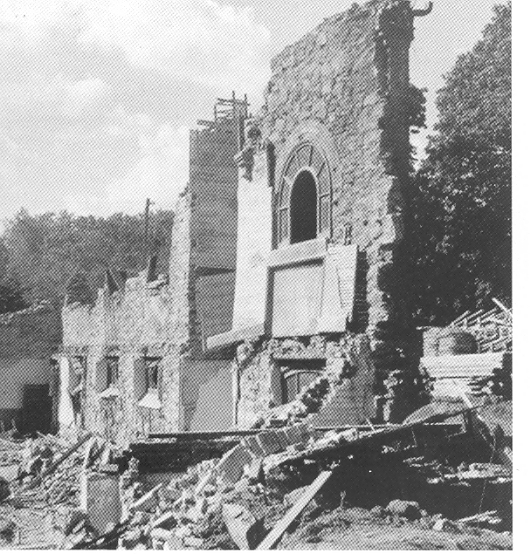
With Father Fee’s leadership and much work and sacrifice on the part of the St. Boniface lay people, a fund-raising campaign began in 1960. The goal of a quarter-million dollars was quickly oversubscribed. Six additional classrooms were completed within the original school building, an extension providing for thirteen sisters was added to the convent, and an adjacent house was bought and made into a rectory. A new and larger church building was designed and constructed. All of this took until 1964 to complete.
The original church building being torn down in 1964. (click photo to enlarge)
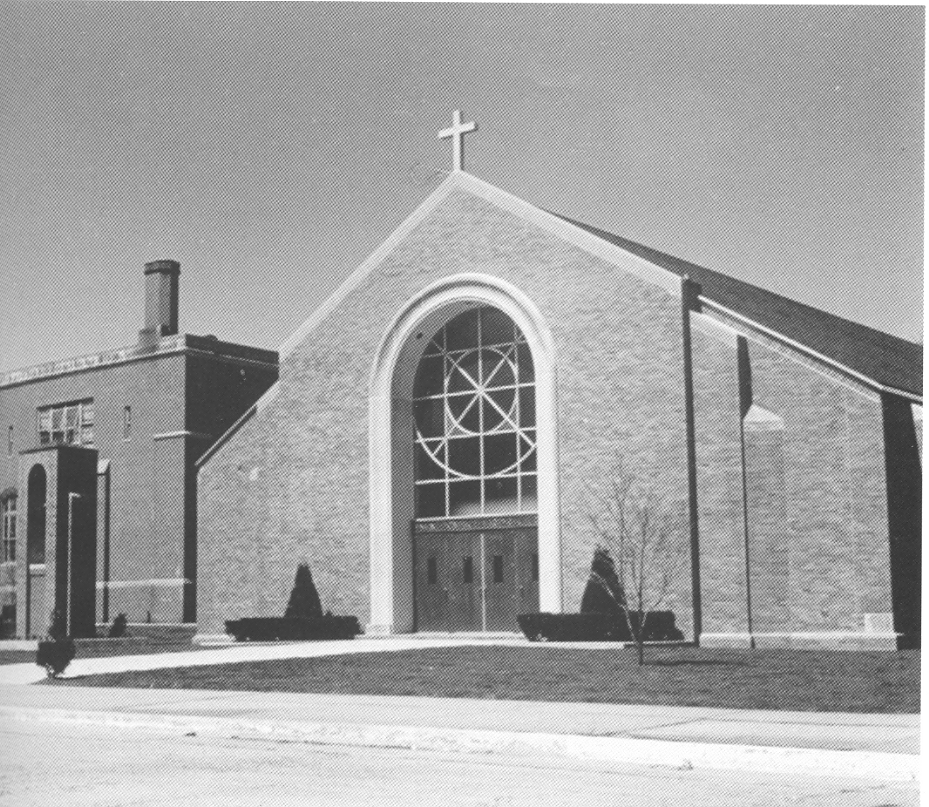
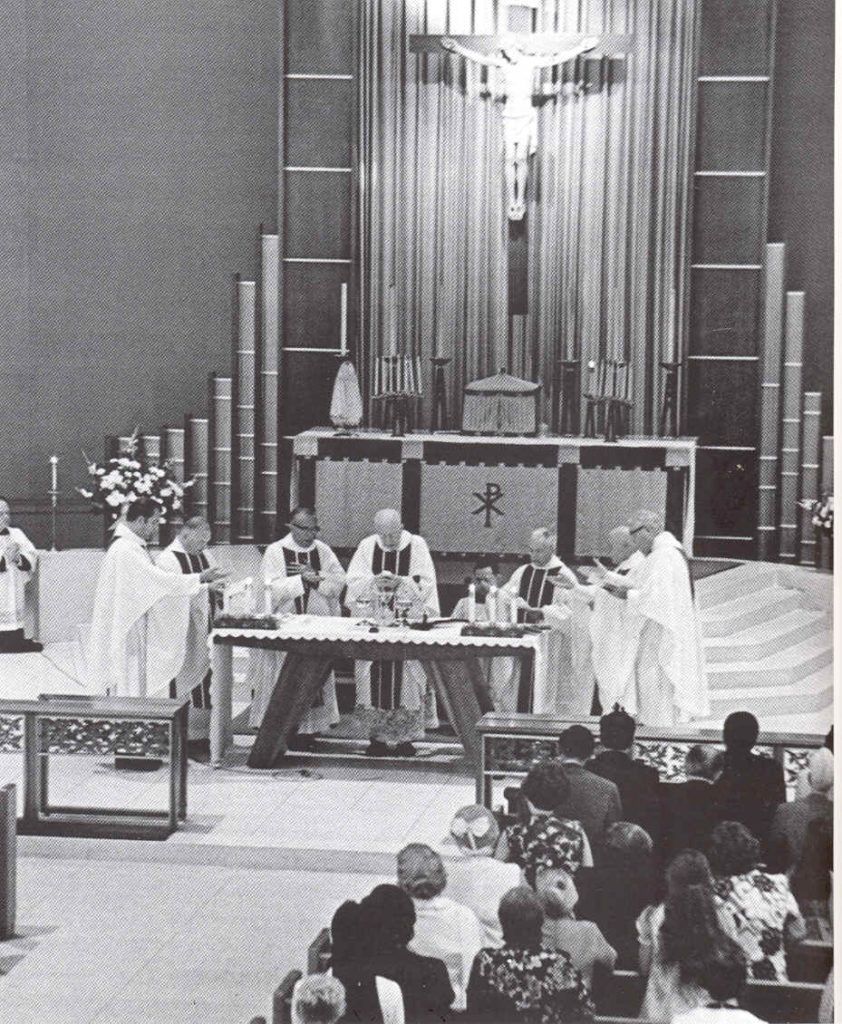
Finally, on May 3, 1964, the Solemn Dedication of the new edifice took place. The Most Reverend Walter P. Kellenberg, D.D., Bishop of the Diocese of Rockville Centre, pontificated, and the Most Reverend Vincent J. Baldwin, S.T.D., V.G., Auxiliary Bishop of Rockville Centre, who had served as pastor in Sea Cliff (1953-56), preached the homily
.
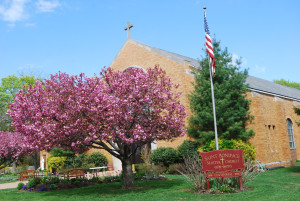
The new church building in 1964. (click photo to enlarge)
There were other familiar faces serving as Officers of the Pontifical Mass that day: Right Reverend Monsignor William J. Gately, Assistant Priest; Very Reverend Monsignor Thomas W. Smiddy and Reverend James F. Bradley, Deacons of Honor; Reverend George F. O’Mara, Deacon; Reverend Joseph F.X. Canning, Subdeacon. The Masters of Ceremonies were the Very Reverend Monsignors Francis J. Williams and John R. McGann.
St. Boniface dedicates its new church on May 3, 1964. (click photo to enlarge)
The souvenir program for the day explained very well the rationale for the new church building, and permitted the architects to describe what they thought they had accomplished:
The new church building we dedicate today replaced the old St. Boniface Martyr Church which stood for more than sixty years on the same site. Much local affection was held for the old church which had become a landmark in town…. [P]arish growth demanded an enlarged, more up-to-date church. In the demolition of the old church, Father Fee had hoped that something of the original building might be incorporated in the new design. The original church bell atop the front facade of the old church was in excellent condition and would provide auditory as well as visual memories of the former place of worship. To bridge this old and new, the old bell has been placed in a free-standing bell tower, and has been made automatic, with clock and manual controls inside the new church.
The design of the church is simplified Romanesque style with contemporary feeling… typified by the large entrance arch of limestone, the slate roof and the circular head windows in the nave and the transepts. The short walls of the transepts… carry carved limestone statues… of the Patron of the Parish… and … of the Patron of the Diocese….
The architects described their use of oak (symbolic of St. Boniface’s having destroyed the Pagans’ sacred tree) in the nave and in the church doors, and of the oak leaf and acorn design in the altar rail, votive stands, lectern and speaker grilles. In great detail they describe the eight stained-glass windows in the transepts which depict “historically accurate events from the life of the patron of the parish”. The four windows in the nave illustrate the Glorious Mysteries of the Rosary and the large entrance window depicts the Coronation of the Blessed Mother as Queen of Heaven and Earth. When the celebration was over it was realized that with the cost of the expansion and of the new buildings and of the purchase of the two adjacent parcels of land, the parish had a $440,000 debt.
While the physical structure of St. Boniface was expanding, so too was the role of its parishioners. Lay activity had always been a hallmark of the parish, but with the advent of Vatican Council II came the formal changes of a Parish Council, a School Board, and a CCD board composed of laymen and laywomen. These lay efforts continued to be reinforced by those organizations already in existence and the Adult Choir and the Folk Group were added.
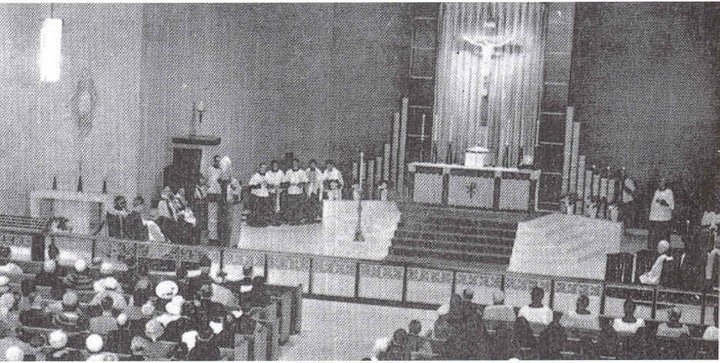
To celebrate its Diamond Jubilee, the parish began 1973 with a New Year’s Party. Two dinner plates were designed to commemorate the occasion of the 75th Anniversary. A Mass of Thanksgiving was celebrated on Sunday, June 24, 1973, with Bishop Kellenberg as the principal celebrant and with Fathers James Bradley, George O’Mara, Joseph Canning, Hubert Spinner, Thaddeus Semla, and, of course, Father Fee, as concelebrants. Father George O’Mara, who had been associate pastor at St. Boniface from 1935 to 1961, gave the homily. The record shows — reflecting Vatican II — that Joseph Vulpis was the cantor and Robert Bolger was the lector.
The 75th Anniversary Mass celebrated on June 24, 1973. (click photo to enlarge)
In 1976, the School Board initiated a parish pre-school program to provide early childhood education for the community. The parish continued to prosper and to grow, and as one observer from outside the parish noted, Father Fee played “a dignified and important role in Sea Cliff,” as well as in the St. Boniface community. He was honored by the North Shore Kiwanis Club as “Citizen of the Year” in 1980 and, when he reached the age of obligatory retirement, continued to reside at the parish as Pastor Emeritus. It was then that the Reverend Donald F. Diederich was installed as pastor.
In the fall of 1982 the priests moved to the newly renovated Parish Center, a building that since 1928 had been the convent for the Sisters of Mercy, and the former rectory was rented to the Sisters of St. Joseph.
May 31, 1983, was the 25th Anniversary of Father Diederich’s ordination. Quite secretly, the parish determined to send Father on a pilgrimage to the Holy Land, which he had never visited. Arrangements were made for him to depart on May 22, so he could celebrate a special mass in that most sacred place, on his actual anniversary. On May 15, Father Dederich was honored at a mass and afterward a reception was held in the school auditorium to wish him well.
Father Fee’s sudden death from a heart attack on November 19, 1983, came as a great shock. Sadly, members of the parish said good-bye to their former pastor of 25 years. The funeral mass for the Pastor Emeritus was celebrated with Bishop John McGann as the principal celebrant.
Father Diederich’s pastorate was marked by strong emphasis on the liturgy. “The parish community begins with the Eucharist, and the other sacraments,” said Father Diederich, “and everything else flows from that.” Among his efforts, a successful half-million dollar fund-raising campaign to renovate the church was realized.
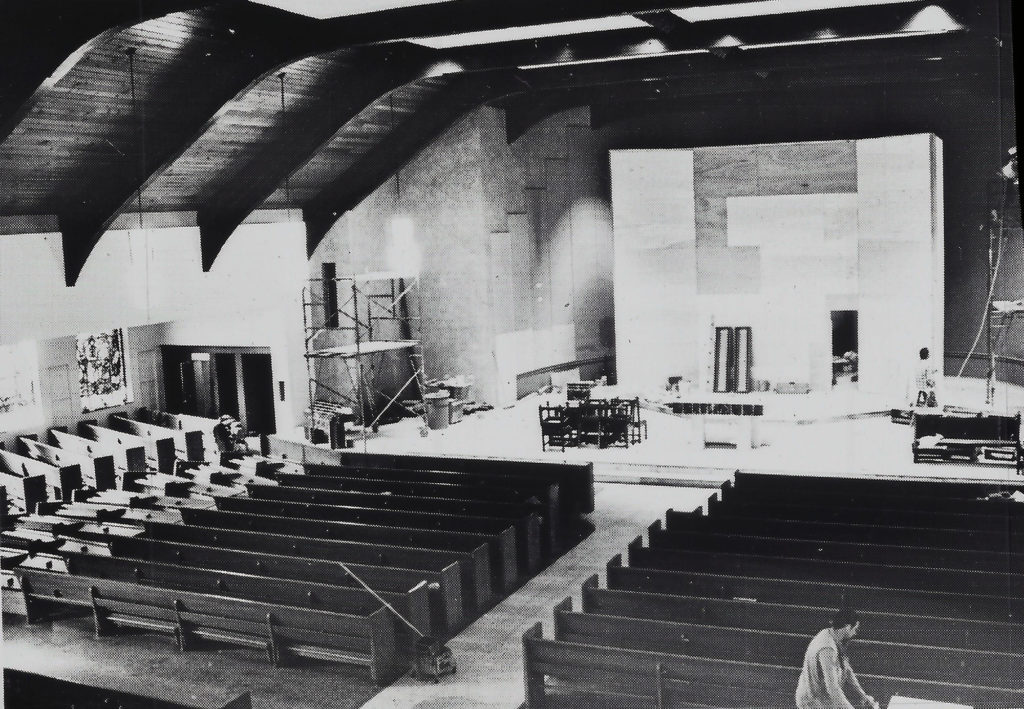
The renovated church, re-dedicated on March 24, 1985, by Bishop McGann, gave St. Boniface a stronger sense of active participation in the liturgy. Further involvement with music was encouraged, and a musical director was hired. The involvement of scores of Eucharistic Ministers and lectors was also enlisted. Changes in the church itself included removal of the altar rail, creation of a permanent altar facing the people, addition of a wide but shallow sanctuary and a repositioning of the pews to bring the congregation and celebrant closer together. The original baptismal font was relocated to the sanctuary and the tabernacle was repositioned to a place of prominence in the sanctuary. Architectural history was preserved by refashioning the original marble altars into a single permanent altar, a substantial base for the tabernacle, and the eye-catching face of the ambo. Original oakleaf fretwork from the communion rail adorned the wall above the tabernacle.
Social concerns were also made more visible by an active Justice and Peace Committee; a parish outreach position was added to the staff and ecumenical ties grew. Social life in the parish was encouraged for the youth by Father Thomas Mulvanerty and, later, paid youth ministers were added. Parish-wide activities such as the Family Luncheon, Country Fair and Service Auction added vitality to St. Boniface’s social life and also to parish funds. A parish census done in 1982, reported 1,447 homes in the parish with 3,902 Catholics.
Sacramental programs involving parents continued to develop under the leadership of Sr. Margaret McPeak, school principal, and Mrs. Ita Levesque, religious education director. Parishioners now helped prepare engaged couples for marriage and new parents for their children’s baptisms. A Mass of Anointing of the Sick and a Marriage Renewal Mass became part of the annual parish calendar, and in 1987, under the direction of Father Jay Madacsi and Maureen Kelly, the restored Rite of Christian Initiation of Adults (RCIA) was celebrated at St. Boniface for the first time. In September, Father Reginald Camilleri arrived at the parish from Malta.
In June of 1988, after eight years as pastor, Father Diederich left St. Boniface to become pastor at St. James Parish in Setauket and Father David Farley was installed as pastor. Though here for only one year, parishioners knew Father Farley to be a kind and gentle man. He will be especially remembered for leading a parish prayer vigil in the spring of 1989, while a St. Boniface student lay in a coma after sustaining a serious injury at school. The entire parish participated in the round-the-clock vigil, until the third grader’s life was out of danger. It stands out as a special moment of faith for St. Boniface — the parish’s own miracle.